Scoliosis Treatment in Urbandale, Iowa: A Proactive Approach to Spinal Alignment, Exercise, and Strength
Medically Reviewed by Dr. Kyle Ruehle, DC — Advanced Spine Health Center, Urbandale, Iowa (serving the Des Moines metro since 2016)
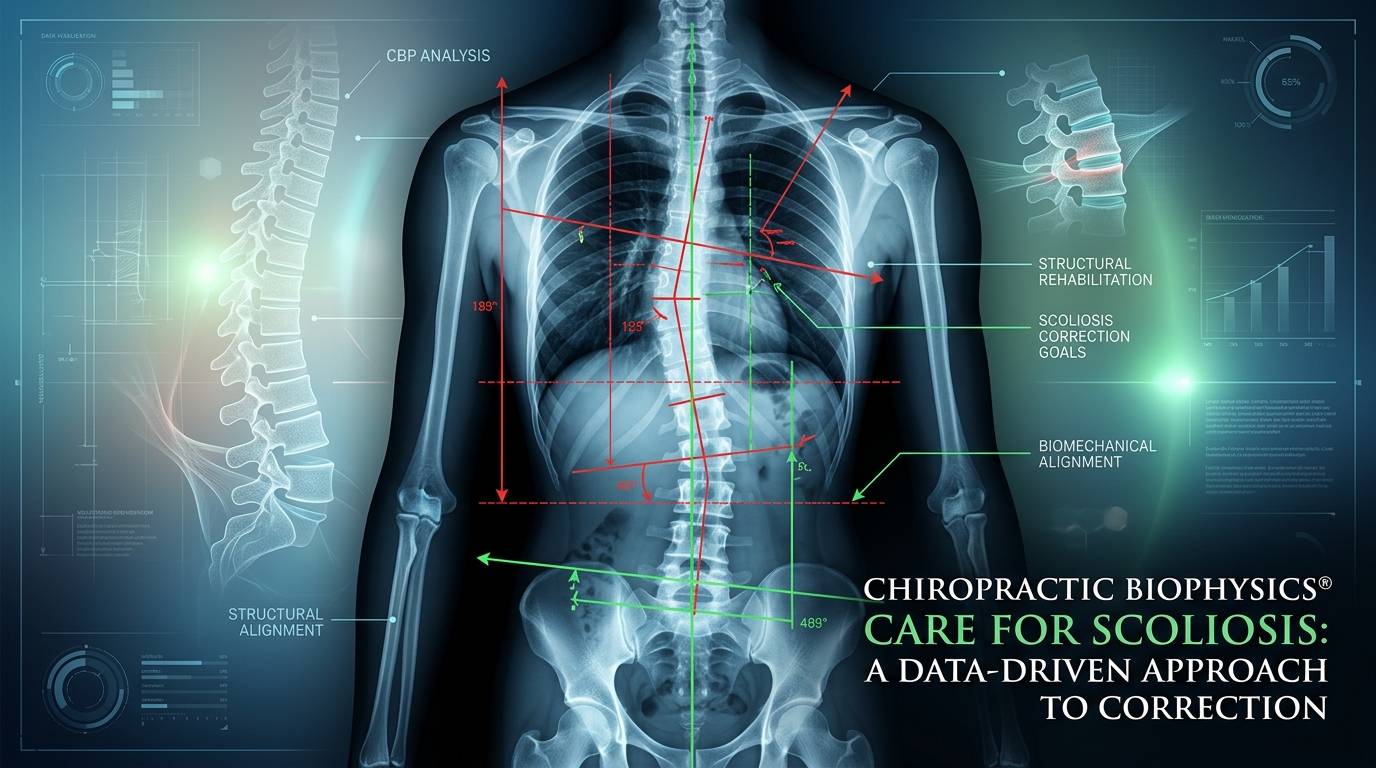
Scoliosis is more than a sideways curve in the spine. It's a three-dimensional change in spinal alignment, and it can show up in posture, balance, movement, strength, and sometimes pain.
At Advanced Spine Health Center in Urbandale, Iowa, we take a proactive approach to scoliosis care for patients throughout the Des Moines metro — including West Des Moines, Clive, Waukee, Johnston, and Ankeny. We don't just measure a curve and wait to see what it does next. We want to know why the spine is shaped the way it is, how likely that curve is to progress, and what can realistically be done about it now.
Our approach draws on Chiropractic BioPhysics® (CBP), mirror-image exercises and adjustments, specialized corrective traction, home exercises, and progressive strength development. We also borrow concepts from established scoliosis-specific exercise approaches like Schroth, SEAS, and ScoliBalance.
We see scoliosis patients of every age — children, teenagers, and adults — but here's the thing we believe most strongly: the earlier a scoliosis problem is identified and evaluated, the more options a patient usually has.
Table of Contents
What Is Scoliosis? | What Causes Scoliosis? | What Causes Scoliosis to Progress? | What Is the Risk of Scoliosis Progressing? | Why We Don't Believe in "Wait and See" | How We Evaluate Scoliosis | How We Approach Scoliosis Treatment | Scoliosis-Specific Exercises | Scoliosis Bracing | Why Strength and Fitness Matter | Treatment at Different Ages | What a Treatment Plan Looks Like | Treatment Goals | FAQ | Schedule a Consultation
What Is Scoliosis?
Scoliosis is a structural change in which the spine develops a curve and a rotation it shouldn't have. It's commonly described as a sideways curve, but the reality is three-dimensional. A scoliosis curve can involve:
- The frontal or side-to-side alignment of the spine
- The normal front-to-back curves of the spine
- Rotation of the vertebrae
- The position of the ribs and trunk
- Shoulder and pelvic alignment
The Cobb angle — the standard measurement used on X-rays — quantifies how big the curve is. It matters, but it's not the whole story. Two people can have nearly identical Cobb angles and still have very different spinal shapes, flexibility, posture, symptoms, and progression risk. That's why our evaluation looks at more than "how many degrees is the curve?"
What Causes Scoliosis?
There are several different types and causes of scoliosis, and they don't all behave the same way.
Adolescent Idiopathic Scoliosis
This is the most common type diagnosed in children and teens. "Idiopathic" simply means there's no single identified cause. We don't fully understand why it develops, but we do know that curve magnitude and skeletal maturity are strong predictors of whether it will progress.
Adult and Degenerative Scoliosis
Adults can carry a curve that started in adolescence, or they can develop a new one as the spine changes with age. Disc degeneration, joint changes, and uneven loading on the spine all play a role, and adult scoliosis is often accompanied by back pain, stiffness, reduced mobility, or symptoms that travel into the legs.
Functional and Postural Contributors
Not every asymmetry we see on a posture exam is the same kind of scoliosis. Pelvic position, leg-length differences, and muscular imbalance can all influence how the spine sits — which is exactly why a good evaluation looks at the whole spinal and pelvic structure, not just the curve itself.
Other Forms of Scoliosis
Scoliosis can also show up alongside congenital spinal abnormalities, neuromuscular conditions, and other medical issues. Not every curve should be treated the same way, and a proper evaluation is what tells us the difference.
What Causes Scoliosis to Progress?
Progression isn't determined by any single measurement. The factors we weigh include:
- The magnitude of the curve
- The patient's age
- How much skeletal growth remains
- Skeletal maturity
- The location and pattern of the curve
- The flexibility of the curve
- The amount of vertebral rotation
- Whether the curve has already shown progression
Of these, curve magnitude and skeletal maturity carry the most predictive weight in the research. A large curve in a child with substantial growth remaining is a very different situation than a similar-sized curve in someone near the end of skeletal maturity — which is exactly why catching scoliosis early matters so much.
What Is the Risk of Scoliosis Progressing?
There's no single percentage that fits every scoliosis patient. Risk comes down to the combination of curve size, age, skeletal maturity, and growth remaining, and research bears this out — one study of more than 600 adolescents found that skeletal maturity and curve magnitude strongly predicted future progression, with the highest-risk groups far more likely to progress into surgical territory. A separate review reached a similar conclusion, pointing to Cobb angle, curve type, and flexibility as the strongest predictors.
That's the real question we're trying to answer for every patient — not just "is this bad enough to treat," but "how likely is this to get worse, and what can we reasonably do about it now?"
Why We Don't Believe in "Wait and See"
Observation has its place. Some smaller curves, particularly in patients close to skeletal maturity, can reasonably be monitored. But monitoring a curve and actively working to improve it are two different things — and we default to the second one whenever it's a realistic option.
Instead of a path that looks like Identify → Measure → Wait → Re-X-ray → Treat if it progresses, we'd rather run:
Identify → Measure → Assess risk → Correct → Strengthen → Stabilize → Reassess
Our philosophy is simple: if there are conservative things we can reasonably do to improve the situation now, we'd rather do them before the curve becomes harder to manage.
That doesn't mean every curve needs aggressive treatment, or that every curve can be corrected. It means we don't think a patient should assume that watching and waiting is the only option on the table. Medical monitoring, bracing, and scoliosis-specific exercise all still have a role here — none of these approaches rules out the others.
How We Evaluate Scoliosis at Advanced Spine Health Center
A treatment plan is only as good as the evaluation behind it. Ours typically combines a postural exam, a physical exam, orthopedic testing, and spinal X-rays.
Posture Examination
We look at the whole body's posture and alignment, not just the spine in isolation — shoulder height, pelvic alignment, trunk position, spinal curves, weight distribution, head and neck position, and any visible asymmetries. That gives us context for how the spine relates to everything around it.
Physical Examination and Adams Forward Bend Test
The Adams forward bend test is a standard part of scoliosis screening, and we pair it with a broader physical exam covering spinal movement, posture, and muscular balance.
X-Ray Evaluation
X-rays show us the actual structure of the spine. Depending on the patient, we'll look at Cobb angles, spinal alignment, vertebral positioning, pelvic alignment, lateral translation, sagittal alignment, and other CBP structural measurements. We're after the overall pattern, not just one number.
Modified Ferguson X-Rays and Leg-Length Evaluation
Leg-length differences can influence pelvic and spinal alignment — but they shouldn't be assumed as the cause of a scoliosis curve without checking. Our modified Ferguson X-ray helps us determine whether a leg-length difference is present and whether it's actually relevant to the patient's alignment, which tells us whether a shoe lift or shim belongs in the care plan.
How We Approach Scoliosis Treatment
Our philosophy here is straightforward too: correct as much of the spinal alignment as reasonably possible, then build as much strength and muscular support around the spine as possible.
Chiropractic BioPhysics® for Scoliosis
CBP is a structural approach to chiropractic care built around analyzing spinal alignment and applying specific corrective forces, exercises, traction, and adjustments. For scoliosis, that means building a corrective strategy around the direction and characteristics of the patient's individual curve — with the goal of changing the structure, not just easing symptoms for a week.
Published CBP case-series research backs this up in a limited way: a 2022 case series of three adults with mild-to-moderate high thoracic scoliosis (17°–26°) reported an average 4.5° reduction in Cobb angle after CBP treatment using stress-X-ray-guided corrective traction, along with patient-reported improvement in pain.1 It's a small case series, so it doesn't prove what every patient should expect — but it does support the plausibility of the approach, and it's a big part of why we individualize each patient's corrective plan instead of promising a specific outcome.
Mirror-Image Exercises
The idea behind mirror-image exercises is to position the body opposite its existing postural or spinal distortion, rather than reinforcing the same position the body already holds. Every patient's curve looks different, so these exercises are built individually rather than pulled from a generic list.
Specialized Corrective Traction
Corrective traction is a different animal than generic spinal decompression. Here, the goal is a specific directional force built around the patient's curve — gently pulling the spine toward the opposite of its existing distortion. How much traction we use depends on the patient's structure, tolerance, and response over time.
Scoli Rolls and Home Corrective Positioning
The work doesn't stop when a patient leaves our office. Depending on what a patient needs, home care might include Scoli Rolls or other positioning strategies that reinforce the corrective direction we're working on in-office. Structural change takes consistency, and that means the home piece matters.
Mirror-Image Adjustments
We can also incorporate specific chiropractic adjustments into a scoliosis plan, built around the patient's own spinal and postural pattern rather than a one-size-fits-all technique.
Decompression When Appropriate
Sometimes decompression fits into the picture too — for instance, an adult with scoliosis who also deals with lower-back pain or disc-related symptoms. That's a different tool for a different job than the corrective traction we use to work on alignment itself, and we try to be clear with patients about which one we're using and why.
Scoliosis-Specific Exercises: Schroth, SEAS, and ScoliBalance
Exercise is a core piece of scoliosis care, and Schroth, SEAS, and ScoliBalance (the exercise approach tied to CBP) are the three most established scoliosis-specific systems.
We're not a certified Schroth, SEAS, or ScoliBalance practice. What we do is build a program that borrows concepts from all three and adapts them to the patient in front of us.
What Are Schroth Exercises?
Schroth uses individualized three-dimensional postural correction, breathing strategies, and muscular control, and the research behind it is genuinely encouraging — especially for adolescent idiopathic scoliosis. A 2024 meta-analysis of 14 randomized controlled trials involving 538 adolescents found that Schroth three-dimensional exercise outperformed conventional physical therapy on Cobb angle, trunk rotation, quality of life, and lumbar extensor strength.2 A separate network meta-analysis of 17 trials and 857 patients found similar improvements for scoliosis-specific exercise generally, compared with conventional rehab.3
None of this guarantees a particular result for a particular patient. But it's good evidence that targeted, scoliosis-specific exercise beats a generic routine.
What Are SEAS Exercises?
SEAS — Scientific Exercise Approach to Scoliosis — is built around active self-correction. Instead of passively holding a patient in a corrected position, SEAS teaches the patient to control their own spinal position through movement and daily activity.
What Is ScoliBalance?
ScoliBalance grew out of the CBP philosophy and follows a similar logic to SEAS: individualized exercises built around the patient's own curve and postural pattern, aimed at getting the patient actively involved in correcting and controlling their own posture rather than just receiving passive treatment.
How Our Exercise Program Uses These Concepts
We're not trying to reproduce any one branded system exactly. Our program comes out of our experience with CBP, layered with what we've learned from Schroth, SEAS, and other evidence-informed approaches — and the exercises we choose are based on the individual patient's spinal pattern, not a standard scoliosis worksheet.
Scoliosis Bracing: Preventing Progression vs. Correcting Alignment
Bracing matters most for growing adolescents whose curves carry a real risk of progression — but not every brace shares the same goal.
Traditional Medical Scoliosis Bracing
Traditional TLSO-style braces are generally prescribed to keep a curve from progressing during growth, and the evidence for this is strong in the right patients: growing adolescents with curves in a range where progression is a real concern.
The landmark Bracing in Adolescent Idiopathic Scoliosis Trial (BrAIST) found that bracing significantly cut the odds of a curve progressing to the surgical threshold. In the randomized cohort, 75% of braced patients reached treatment success, compared with 42% in the observation group — and more hours of brace wear meant better odds.4 A brace built primarily to prevent progression can be extremely valuable, even when its job isn't to shrink the curve that's already there.
What Is ScoliBrace?
ScoliBrace takes a different angle: it's a fully customized, three-dimensional brace built to actively influence the existing curve, not just hold it in place. The evidence base is smaller than what backs conventional bracing, but it's promising. A 2024 pilot study followed 30 girls (average age 11.85) with adolescent idiopathic scoliosis; among the 21 who completed the study, 57.14% saw at least a 5° reduction in Cobb angle by skeletal maturity, and more hours of brace wear tracked with better results.5
Traditional Bracing vs. ScoliBrace
| Factor | Traditional Bracing (e.g., TLSO/Boston Brace) | ScoliBrace |
|---|---|---|
| Primary goal | Prevent progression to the surgical threshold | Prevent progression and actively influence 3D alignment |
| Design approach | Standardized brace shapes fitted to the patient | Fully customized, 3D scan-based corrective design |
| Strength of evidence | Large multicenter randomized trial (BrAIST) | Smaller pilot studies; growing but limited evidence base |
| Typical candidates | Growing adolescents, Cobb angle roughly 20°–40° | Growing adolescents seeking a corrective, not just preventive, approach |
| Reported outcome | 75% treatment success vs. 42% with observation4 | 57.14% had ≥5° Cobb angle reduction at skeletal maturity5 |
Preventing Progression vs. Improving the Curve
These are related goals, but they're not the same thing, and neither one comes with a guarantee. The right call depends on the patient — age, skeletal maturity, curve size and pattern, progression risk, and personal circumstances all factor in. For some patients, a medical brace makes the most sense. For others, scoliosis-specific exercise or structural correction — or some combination — is the better fit.
Why Strength and Physical Fitness Matter in Scoliosis
Scoliosis care shouldn't stop at repositioning the spine. We also want the patient to come out stronger, because a stronger, more capable body supports itself better, tolerates more physical demand, and holds onto good movement patterns.
Building muscle alone won't straighten a structural curve — but strength is what carries a corrected posture forward for years afterward, not just for the length of a treatment plan. A 2024 meta-analysis of 19 studies and 778 adolescents found that both Schroth exercise and strength training were tied to better Cobb-angle outcomes compared with control groups.6
Why We Encourage Strength Training
We want our patients strong, active, and physically capable long after they've finished corrective care — through core and back work, leg and hip strengthening, progressive resistance training, cardiovascular fitness, and whatever sports or recreational activity they actually enjoy. We can provide the corrective exercises and the guidance, but the long-term strength piece eventually becomes the patient's own — most people end up transitioning from office-based rehab into regular training at home or at a gym.
Correction Plus Strength
Correct what we can. Then strengthen what supports it. We don't want a patient to spend months on posture and alignment only to go back to a sedentary routine with nothing holding the gains in place.
Scoliosis Treatment at Different Ages
The right approach changes quite a bit depending on where a patient is in life.
Scoliosis in Children
Early evaluation matters most here, simply because a child usually has the most growth — and therefore the most progression risk — still ahead of them. That doesn't mean every child needs aggressive treatment. It means we'd rather have real information early than find out later that a window to act was missed.
Scoliosis in Adolescents
Adolescence is the highest-stakes window for scoliosis, because rapid growth and curve progression tend to go hand in hand. For teens, we're weighing curve size and pattern against how much growth is likely left, how the curve has behaved so far, and which conservative options — bracing, exercise, or both — make the most sense.
Scoliosis in Adults
Adults benefit from evaluation too, whether they're carrying a curve from adolescence or one that developed later with age-related changes. Care here tends to focus less on reshaping a fixed curve and more on pain, mobility, strength, and day-to-day function, along with whatever disc or joint issues have come along with it. Adults don't need to wait for a curve to become severe before getting it looked at.
What Does a Scoliosis Treatment Plan Look Like?
- Consultation and Examination — we start with the patient's history, symptoms, goals, activity level, and any previous scoliosis treatment.
- Postural and Physical Assessment — evaluating posture, spinal movement, asymmetries, and other physical findings.
- X-Ray and Structural Evaluation — measuring the curves and the overall structural alignment when appropriate.
- Identify Contributing Factors — pelvic alignment, leg-length differences, spinal alignment, curve pattern, and anything else relevant.
- Develop a Corrective Strategy — mirror-image exercises, corrective traction, mirror-image adjustments, and home positioning.
- Continue Corrective Work at Home — the exercises and positioning that reinforce what happens in-office.
- Build Strength — layering in strength work as the corrective phase progresses.
- Reassess — checking progress against symptoms, function, posture, and, when it's called for, follow-up imaging.
What Are the Goals of Scoliosis Treatment?
A single number on an X-ray was never the whole point. Depending on the patient, we're working toward better spinal alignment and posture, less pain, better mobility and function, real strength gains, an active day-to-day life, a lower risk of further progression, and — when conservative care is a realistic option — avoiding more invasive treatment down the road.
No conservative approach can promise that a curve will stop progressing, or that surgery will never come up. But catching a problem early, understanding what's driving it, and doing the corrective and strength work that's actually available — that's worth pursuing, guarantee or not.
Frequently Asked Questions About Scoliosis
Can chiropractic care help scoliosis?
It can be part of a comprehensive, conservative plan. Our own approach leans on structural assessment, CBP, mirror-image exercises and adjustments, corrective traction, and strength work — the goal is to change alignment and function, not just make someone feel better for a week.
Can chiropractic care straighten scoliosis?
Sometimes, to a degree — but it's never guaranteed, and it depends heavily on age, curve pattern, flexibility, and how the person responds to care. We won't tell you every curve can be fully straightened, because that isn't true.
Can scoliosis be corrected without surgery?
For a lot of patients, yes — meaningful improvement in alignment and function is possible with conservative care alone. Others end up needing a brace or a surgical consult because of how severe or fast-moving the curve is. It really comes down to the individual case.
Should scoliosis be treated or simply monitored?
Sometimes monitoring is the right call, especially with a small curve in a patient who's close to done growing. What we push back on is the assumption that watching and waiting is the only option — most patients are better served by understanding their odds of progression and their conservative options before deciding to do nothing.
What is the Cobb angle?
It's the standard X-ray measurement used to size up a scoliosis curve. It's useful, but it's one number — it doesn't capture flexibility, rotation, or how the rest of the spine and pelvis line up.
What is corrective traction for scoliosis, and is it the same as spinal decompression?
No. Corrective traction applies a specific directional pull built around your particular curve, pushing the spine toward the opposite of its existing distortion. Decompression is generally used for issues like low back pain or disc-related symptoms instead. The two can show up in the same treatment plan, but they're solving different problems.
What is the difference between Schroth and SEAS exercises?
Both are scoliosis-specific — neither is a generic stretching routine — but they get there differently. Schroth leans on individualized 3D postural correction, while SEAS is built around active self-correction patients can carry into daily movement.
Does Advanced Spine Health Center provide Schroth or SEAS therapy?
We're not a certified Schroth or SEAS practice. What we do is borrow concepts from Schroth, SEAS, ScoliBalance, and other scoliosis-specific approaches and adapt them to each patient's own curve pattern.
What is ScoliBrace, and is bracing effective for scoliosis?
ScoliBrace is a fully custom, 3D corrective brace built to actively influence spinal alignment rather than just hold a curve in place. As for bracing generally: yes, for the right growing adolescent, it works — the BrAIST trial found 75% treatment success with bracing versus 42% with observation alone.4
Should someone with scoliosis lift weights?
Generally, yes, when it's set up appropriately for their condition. Research has tied both scoliosis-specific exercise and strength training to better Cobb-angle outcomes.6 The exercises just need to fit the person's ability and their particular curve.
Can a leg-length difference affect scoliosis?
It can influence pelvic and spinal alignment in some people, but it's not a blanket explanation for every case — which is exactly why we check for it rather than assume it either way.
Can adults with scoliosis benefit from treatment?
Yes. Growth isn't the point anymore, but alignment, mobility, strength, and pain still are — an adult curve is worth evaluating even when surgery or bracing were never on the table.
Scoliosis Treatment in Urbandale, Iowa
If you or your child has been diagnosed with scoliosis, you don't have to choose between waiting for the curve to worsen and jumping straight to invasive treatment. There's real middle ground here, and the right combination of approaches depends on the person.
At Advanced Spine Health Center, we start by understanding the structure of the spine, figuring out what's influencing its alignment and progression, and working proactively on whatever we can actually change. That may mean CBP, mirror-image adjustments and exercises, specialized corrective traction, home corrective work, and progressive strength development — and we're just as quick to point patients toward medical monitoring, conventional or corrective bracing, or scoliosis-specific exercise when that's the better fit.
We're not going to claim one treatment works for everyone. What we want is for every patient throughout Urbandale and the greater Des Moines metro to understand their own spine, know their options, and build the strongest, most functional version of it they can.
If you'd like your scoliosis evaluated, contact Advanced Spine Health Center in Urbandale, Iowa to schedule a consultation.
References
- Oakley PA, Kallan SZ, Harrison DE. The reduction of high thoracic scoliosis in adults by mirror image® blocking: a Chiropractic BioPhysics® case series. J Phys Ther Sci. 2022;34(6):467-472. PMID: 35698559.
- Chen C, Xu J, Li H. Effects of Schroth 3D Exercise on Adolescent Idiopathic Scoliosis: A Systematic Review and Meta-Analysis. Children. 2024;11(7):806. PMCID: PMC11275065.
- Physiotherapeutic Scoliosis-Specific Exercise for the Treatment of Adolescent Idiopathic Scoliosis: A Systematic Review and Network Meta-analysis. Am J Phys Med Rehabil. 2024. PMID: 38726971.
- Weinstein SL, Dolan LA, Wright JG, Dobbs MB. Effects of Bracing in Adolescents with Idiopathic Scoliosis. N Engl J Med. 2013;369:1512-1521.
- Lim KBL, Mak HKW, Abdul Rahaman SH, et al. A pilot study on the "ScoliBrace" in the treatment of adolescent idiopathic scoliosis. Eur J Orthop Surg Traumatol. 2024;34:1803-1809. PMID: 38416233.
- Efficacy of Different Exercises on Mild to Moderate Adolescent Idiopathic Scoliosis. Am J Phys Med Rehabil. 2024;103(6):494-501.