Platelet Rich Plasma Injections in Urbandale, IA: A Complete Guide to PRP Injection Therapy
Medically reviewed by Dr. Kyle Ruehle, DC · Last updated [7/28/2026]
Quick summary: Platelet-rich plasma (PRP) is a biologic injection made from your own concentrated blood platelets, used to support healing in tendons, ligaments, joints, and other soft tissue injuries. At Advanced Spine Health Center in Urbandale, IA, we pair ultrasound-guided PRP with correction of the structural and functional issues behind the injury, and that combination is what gives our patients better results than PRP on its own. We do this while keeping our pricing among the most affordable in the Des Moines area, so a complete treatment plan doesn’t come with a premium price tag.
On this page: What Is PRP · How It Works · What the Research Shows · Conditions We Treat · Comparing Your Options · Who’s a Candidate · What to Expect · Timeline & Results · FAQ
Key Takeaways
PRP concentrates platelets from your own blood to support the body’s natural healing response.
It’s commonly used for tendon injuries, ligament problems, joint conditions, arthritis, and other orthopedic soft tissue injuries.
PRP works best when paired with correcting whatever caused the injury in the first place — weakness, poor mechanics, instability, or structural problems.
Ultrasound guidance allows more precise placement of PRP into the exact tissue that needs it.
A thorough evaluation — not just “where does it hurt” — determines whether PRP is the right fit.
What Are PRP Injections?
Platelet-rich plasma is prepared by drawing a small amount of your blood and placing it in a centrifuge, which spins the sample to separate the plasma from the red and white blood cells and to concentrate the platelets.The result — platelet-rich plasma — is then injected into the injured area.
Platelets are best known for clotting blood, but they also carry growth factors and signaling proteins that drive tissue repair, including collagen production, new blood vessel formation, and cell-to-cell communication involved in healing.
PRP isn’t designed to instantly repair damaged tissue. It’s designed to create a better healing environment by delivering a concentrated dose of your body’s own repair signals directly where they’re needed.
Because it’s made from your own blood, allergic reactions are rare. That said, PRP isn’t the right treatment for every patient or every condition — the diagnosis, severity of damage, and other factors all affect whether it’s likely to help.
How Does PRP Work?
Healing requires a coordinated sequence: inflammation, cellular signaling, tissue repair, and remodeling. Platelets play a central role in that sequence by releasing the growth factors that trigger repair.
PRP concentrates those platelets and delivers the concentrated platelets straight to the affected area, with the goal of supporting a stronger healing response, better tissue remodeling, healthier collagen formation, and improved blood vessel development in the area.
This matters most for chronic injuries. Long-term tendon problems usually aren’t just inflammation — they often involve structural tendon changes where normal healing has stalled. PRP may help restart the body’s healing processes and help heal damaged tissue, while rehab rebuilds the strength and stability the tissue needs going forward.
What Does the Research Say About PRP?
Evidence quality varies by condition. Here’s where it’s strongest:
Knee osteoarthritis. Multiple systematic reviews and meta-analyses — including a well-cited 2015 review in the British Journal of Sports Medicine — have found PRP can improve pain and function for many patients with mild to moderate knee osteoarthritis. A separate 2021 meta-analysis of randomized controlled trials, published in the American Journal of Sports Medicine, found PRP outperformed hyaluronic acid injections for knee osteoarthritis on several outcome measures. PRP isn’t expected to reverse advanced arthritis or replace treatment when there’s significant joint damage, but it may meaningfully help appropriately selected patients.
Tendon injuries. Research, including a widely cited 2017 meta-analysis in the American Journal of Sports Medicine, has looked at PRP for chronic tendon conditions such as tennis elbow, patellar tendon injuries, Achilles tendon problems, and rotator cuff–related conditions. Results aren’t uniform across every condition, but many studies point to benefit — particularly when PRP is combined with proper rehabilitation.
Injection accuracy. A 2024 umbrella review in the Journal of Rehabilitation Medicine, which pooled 17 systematic reviews and meta-analyses, found ultrasound-guided injections are generally more accurate than landmark-guided (touch-and-feel) injections, with the clearest benefit in the shoulder, hip, wrist, and knee. For PRP, that accuracy matters because the treatment only works if it actually reaches the tissue that needs it.
PRP Is a Tool — Not the Whole Plan
We tell patients this constantly: PRP is a great tool for helping tissue heal, but it doesn’t replace the physical therapy needed to strengthen muscle, improve function, or restore function through structural correction. An injection can support healing tissue — it can’t fix why that tissue got injured in the first place.
Our office practices Chiropractic BioPhysics (CBP), so we place real weight on structure alongside the injection itself — not before it or after it, but combined with it, based on what that specific patient’s problem calls for. That means evaluating spinal curvature and angles, anatomical leg length, pelvic tipping, and scoliosis, along with things like thoracic hyperkyphosis (excess rounding of the upper back, which places significant strain on the shoulders) and arch drop from sitting to standing (which can be a major contributor to knee pain). These structural issues quietly overload joints and tendons for years before an injury ever shows up, and they don’t resolve on their own just because a joint got injected.
Once structure is accounted for, function is the other half of the equation — building strength, improving stability, and restoring flexibility so the tissue can actually handle normal load again. Alongside that, we use pain-focused therapies like red light therapy and spinal decompression to support the process and keep patients comfortable while the deeper work happens.
PRP fits into this as biological support for the injured tissue itself — one piece of a plan built around structure, function, and pain relief working together, not PRP carrying the whole load by itself.
We’ve found the patients who get the best results from PRP tend to have two things in common: mild-to-moderate tissue damage (which doesn’t necessarily mean mild pain — pain severity and tissue damage don’t always match), and a treatment plan that also corrects any structural or functional issues contributing to the problem. For many patients, that makes PRP worth considering before surgical intervention or other invasive treatments. A lot of clinics offer PRP on its own, without structural assessment or real rehabilitation behind it — and for patients who do have an underlying structural or functional issue, that often leads to lackluster results, regardless of how good the injection itself is.
Before recommending PRP, we ask:
What tissue is actually injured?
What structural or biomechanical issue caused it?
Why hasn’t it healed on its own?
What’s still loading that tissue every day?
Conditions PRP Injections May Help
PRP is used across a range of orthopedic conditions and musculoskeletal injuries involving tendons, ligaments, joints, and muscles. It tends to work best on tissue that’s capable of healing but hasn’t recovered with conservative care. Common applications include:
Chronic tendon injuries
Ligament injuries
Joint pain and arthritis
Partial tendon tears
Muscle injuries
Soft tissue injuries unresponsive to steroid joint injections, rest, medication, or therapy
PRP for Knee Arthritis and Knee Pain
Knee osteoarthritis is one of the most researched applications for PRP. For mild to moderate cases, it may reduce pain, improve function, encourage healing, and help patients delay more invasive options. It’s commonly considered for persistent joint pain when conservative care hasn’t been enough.
Knee pain isn’t always just arthritis, though. We also look at structural contributors through a CBP lens — anatomical leg length differences, pelvic tipping, and alignment — since that evaluation also helps determine whether PRP is appropriate for the knee issue or whether it’s too advanced for this approach. We also check arch drop, comparing the foot’s arch from sitting to standing, since a significant collapse can put ongoing stress on the knee that no injection will fix on its own. Along with muscle weakness, hip and lower-extremity strength, and foot mechanics, correcting what’s overloading the knee is often just as important as treating the joint itself.
PRP for Shoulder Pain and Rotator Cuff Injuries
PRP may help with rotator cuff tendinopathy, partial rotator cuff injuries, and other chronic shoulder tendon irritation. Because the shoulder depends on tight coordination between muscles, tendons, and surrounding structures, we also assess shoulder strength, stability, range of motion, and movement patterns. We pay particular attention to thoracic hyperkyphosis — excess rounding of the upper back — since it places significant, ongoing strain on the shoulders and is a structural factor we frequently see contributing to shoulder pain that doesn’t fully resolve with injections alone.
PRP for Tendon Injuries and Tendonitis
Tennis elbow and golfer’s elbow. Lateral and medial epicondylitis involve tendon irritation and degeneration around the elbow that often persists despite rest and therapy. PRP may support tendon remodeling while rehab restores load tolerance.
Achilles tendon injuries. Chronic Achilles problems may respond to a combination of PRP, progressive strengthening, movement correction, and activity modification.
Patellar tendon injuries (jumper’s knee). Common in athletes; PRP may be considered when symptoms persist despite appropriate rehab.
PRP for Ligament Injuries
PRP may be an option for partial ligament injuries — such as MCL or LCL injuries — where the ligament is damaged but still capable of healing. Complete tears or major instability usually need further evaluation before deciding on treatment.
PRP for Low Back Pain, SI Joint Pain, and Sciatica
Low back pain has many possible sources: ligaments, muscles, joints, discs, nerve irritation, or movement dysfunction. PRP may help in appropriate cases involving SI joint pain, soft tissue–related low back pain, certain disc-related conditions, and some presentations of sciatica — but identifying the actual pain generator matters more than treating “the back” generically. As a CBP practice, our evaluation places real weight on spinal curvature, angles, and alignment, alongside neurological function, muscle strength, posture, and movement patterns, to figure out what’s actually driving the problem.
Other Conditions
PRP may also be considered for muscle injuries, carpal tunnel–related soft tissue irritation, and other chronic tendon or joint-related pain — depending on the specific diagnosis and whether the tissue is likely to respond.
PRP vs. Wharton's Jelly vs. Hyaluronic Acid vs. Corticosteroids
These are the four injections we’re asked about most often, and they’re not interchangeable — each is designed to accomplish something different. Which one (or which combination) makes sense depends on the diagnosis, severity, and goals of treatment.
| Injection | What It's Trying to Accomplish | Pros | Cons |
|---|---|---|---|
| Corticosteroid | Reduce inflammation quickly for short-term pain relief | Fast-acting; inexpensive; often covered by insurance; effective for calming an acute flare-up | Doesn't address the underlying tissue damage; relief is often temporary; repeated use over time may weaken tendons or cartilage |
| Hyaluronic acid | Add lubrication and cushioning to a joint | Can improve joint mobility and reduce friction-related pain; well-established option, especially for knee osteoarthritis | Doesn't address the underlying tissue or structural cause; effects are temporary and often need repeat injections; some research has found PRP outperforms it for knee osteoarthritis |
| PRP | Concentrate your own platelets and growth factors to stimulate and support the body's natural healing | Uses your own blood, so allergic reaction risk is low; uses the healing properties of your own blood to support tissue healing, not just symptom relief; growing evidence base for tendon and joint conditions | Works gradually over weeks, not days; typically not covered by insurance; results depend on the tissue's capacity to heal and whether contributing factors are addressed |
| Wharton's Jelly | Add structural scaffolding and tissue support to more significantly damaged tissue | Offers additional structural support beyond what PRP alone provides; no blood draw required; may help when tissue damage is more extensive | Costs more than PRP alone; evidence base is less established than PRP's; not necessary or appropriate for milder injuries |
We often use these treatments in combination rather than in isolation — for example, a corticosteroid to calm an acute flare while PRP works over the following weeks, or PRP paired with Wharton’s Jelly for more significant tissue damage. Determining the right combination, if any, is part of the evaluation we do before recommending treatment, and prp shots are just one tool within a broader plan depending on the diagnosis and goals.
Who Is a Good Candidate for PRP?
Good candidates typically have a clearly identified source of pain, mild-to-moderate tissue damage, a condition that hasn’t improved enough with conservative care, tissue healthy enough to respond, and a willingness to address structural or functional issues alongside the injections.
One thing worth clarifying: mild-to-moderate tissue damage doesn’t necessarily mean mild pain. Pain intensity and the actual degree of tissue damage don’t always line up — some patients with fairly significant pain still have tissue that’s a great candidate for PRP, and vice versa. That’s part of why an evaluation matters more than the pain scale alone.
PRP may not be the right fit when the diagnosis is unclear, the problem needs surgical evaluation, there’s severe tissue destruction, significant neurological involvement requires a different type of care, or the underlying cause of the injury hasn’t been identified. Cases involving major structural damage may need review by an orthopedic surgeon rather than relying on PRP alone. That doesn’t mean these patients can’t improve — it means the treatment plan needs to match the actual problem, which may call for a more comprehensive approach than PRP alone.
What to Expect During PRP Treatment
The Evaluation
Before recommending PRP, we review your medical history, how your symptoms started, what you’ve already tried, your pain pattern, and your physical exam findings — plus factors that influence healing, like muscle strength, joint stability, nerve function, posture, spinal structure, and gait.
We also review your current medications, since certain ones — especially anti-inflammatory medications — may need to be paused before or after a PRP injection because they can interfere with the healing process and affect whether you’re ready for the procedure. Review any medication questions with your healthcare provider.
The Injection Process
Blood draw — a small sample of whole blood, typically from the arm.
Processing — the blood is spun in a centrifuge to separate it into blood components so the platelet-rich portion can be isolated from other blood components and concentrated into PRP.
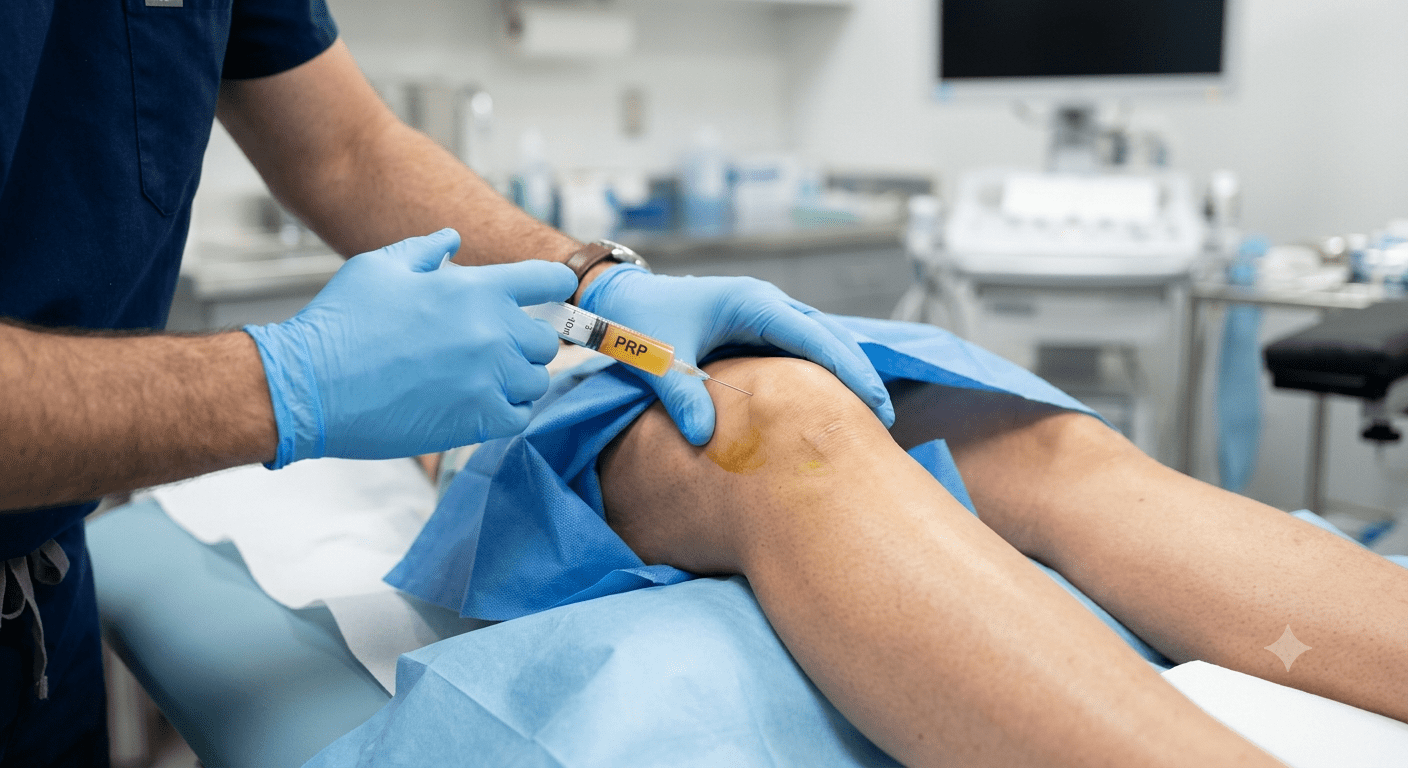
Ultrasound-guided injection — as an outpatient procedure, PRP is delivered into the targeted tissue in real time, and ultrasound imaging helps place the injection accurately while confirming placement, avoiding surrounding structures, and improving precision — especially important for smaller or deeper structures.
The procedure itself typically takes about 30–45 minutes, though total visit time can vary depending on review, prep, the blood draw, processing, injection, and aftercare instructions.
PRP Combined With Wharton's Jelly
Some patients ask about pairing PRP with Wharton’s Jelly, a biologic tissue matrix that may offer additional structural support. PRP provides the growth-factor signaling; Wharton’s Jelly adds tissue support. We may recommend combining the two for more significant tissue damage — the right choice depends on injury severity, patient goals, and cost.
After the Injection
Mild soreness, tenderness, temporary stiffness, bruising, and swelling and pain for a few days after the injection are common and reflect the body responding to the injection. Temporary increased pain at the injection site can also happen. Most patients resume normal daily activities quickly, avoiding strenuous exercise on the day of the injection and following an individualized activity plan afterward. Rehabilitation typically starts alongside PRP, not after it — a stronger, more stable body gives the tissue a better environment to heal in. Serious complications and other potential risks are uncommon, though as with any injection, there is a small risk of infection, and less common issues can include tissue damage, nerve injuries, and scar tissue formation at the injection site.
PRP Treatment Timeline: When Will You Notice Improvement?
Most patients begin noticing improvement often within a few weeks, though timelines vary.
| Timeframe | What to expect |
|---|---|
| First few days | Injection-site soreness, mild swelling, temporary irritation |
| Weeks 1–3 | Less pain, improved movement, better activity tolerance |
| 1–2 months | Progress evaluation; decide whether additional rehab or another PRP round is needed. Full healing can take several months depending on the condition being treated. |
Our typical protocol is three injections, spaced one to two weeks apart, followed by a period of healing and rehab before reassessing.
How long results last really depends on the individual case — the severity of the original injury, and whether the structural and functional issues behind it are corrected and then maintained. When structure is corrected and a patient stays consistent with the strength and stability work on their end, results can last for years, and for some patients, the original problem may not come back at all. Patients who don’t address those contributing factors, or who have more significant underlying damage, tend to see results fade sooner.
Frequently Asked Questions
Does a PRP injection hurt? Most patients tolerate it well. The injection itself is brief, though this varies by location and tissue condition. Mild soreness or temporary stiffness afterward is common and part of the normal healing response.
How long does it take for PRP to work? Most patients notice improvement within one to three weeks, with continued gains over the following weeks as tissue healing progresses and rehab restores strength and function.
How many PRP injections will I need? Our typical protocol is a series of three injections, spaced one to two weeks apart, alongside rehabilitation. We reassess typically after 2 months to decide if further treatment is needed.
How long do PRP results last? This depends on the individual case — the severity of the original injury, and whether the structural and functional issues behind it are corrected and then maintained. When structure is corrected and a patient stays consistent with strength and stability work, results can last for years, and for some patients, the original problem may not return at all. Results tend to fade sooner for patients who don’t address those contributing factors or who have more significant underlying damage.
Is PRP better than a cortisone injection? They’re designed to do different jobs. Cortisone calms inflammation for short-term relief, while PRP works over several weeks to support tissue healing. See the comparison table above for a full side-by-side.
Can PRP help me avoid surgery? In some cases, yes — PRP can help patients improve enough to avoid or delay surgery and may help some patients delay or avoid more invasive treatments. It isn’t a substitute for surgery in every situation; that depends on injury type, severity, and how you respond to conservative treatment.
Is PRP effective for arthritis? It may help, particularly with mild to moderate knee osteoarthritis. Response tends to be less predictable with more advanced joint changes, which is why we evaluate severity, alignment, and function before recommending it.
Is PRP covered by insurance? PRP is usually considered elective and is commonly not covered by traditional insurance. Coverage varies by plan.
How much do PRP injections cost? Prices for PRP vary widely between clinics in the Des Moines area, and can range dramatically depending on the provider and package. We keep our pricing among the most affordable in the area for a full three-injection series. For current pricing, see our [PRP pricing page →].
PRP vs. Wharton’s Jelly — which is better? Neither is universally “better” — they accomplish different things. PRP provides growth-factor signaling to stimulate healing; Wharton’s Jelly adds structural tissue support for more significant damage. See the comparison table above for the full breakdown.
What Makes Advanced Spine Health Center Different
Many clinics inject the painful spot and stop there. Our medical professionals evaluate the entire problem first — not just the painful spot, but what tissue is injured, what structural issue caused it, why it hasn’t healed, and what still needs to change for recovery to hold. That evaluation may include a physical exam, muscle and neurological testing, X-rays when appropriate, and a full CBP structural analysis — spinal curvature and angles, leg length, pelvic tipping, posture, and gait.
We give real weight to structure — if someone’s spine, pelvis, or lower extremities are misaligned, that’s often a root cause we need to address alongside the injury itself, not after it. From there, we build function back — strength, stability, and flexibility — and use therapies like red light therapy and spinal decompression to manage pain and support the process along the way. PRP fits into that plan as one more tool, not a substitute for the rest of it, reflecting orthopedics and sports medicine principles for injuries that need both precise injection care and rehabilitation.
Is PRP Right for You?
The first step is a comprehensive evaluation — one that looks at structure and function, not just the painful spot — to determine what’s actually causing your symptoms and whether PRP fits your situation.
We’d be glad to walk through that with you. Advanced Spine Health Center provides ultrasound-guided injections platelet rich plasma in Urbandale, Iowa, serving West Des Moines, Waukee, Des Moines, Johnston, Grimes, Clive, Beaverdale, and surrounding communities, and if your case calls for outside orthopedic input, we can direct you to orthopedic specialists when appropriate.
Contact our office / Schedule an evaluation
About the Author
Dr. Kyle Ruehle, DC, has practiced chiropractic care in the Des Moines area since 2016, specializing in Chiropractic BioPhysics (CBP), a certified structural correction technique focused on restoring proper spinal curvature and alignment.
References
Laudy ABM, Bakker EWP, Rekers M, Moen MH. Efficacy of platelet-rich plasma injections in osteoarthritis of the knee: a systematic review and meta-analysis. Br J Sports Med. 2015;49:657–672. https://pubmed.ncbi.nlm.nih.gov/25416198/
Fitzpatrick J, Bulsara M, Zheng MH. The effectiveness of platelet-rich plasma in the treatment of tendinopathy: a meta-analysis of randomized controlled clinical trials. Am J Sports Med. 2017;45(1):226–233. https://pubmed.ncbi.nlm.nih.gov/27268111/
Shen P-C, Lin T-Y, Wu W-T, Özçakar L, Chang K-V. Comparison of ultrasound- vs. landmark-guided injections for musculoskeletal pain: an umbrella review. J Rehabil Med. 2024;56:jrm40679. https://pubmed.ncbi.nlm.nih.gov/39185547/
Belk JW, Kraeutler MJ, Houck DA, Goodrich JA, Dragoo JL, McCarty EC. Platelet-rich plasma versus hyaluronic acid for knee osteoarthritis: a systematic review and meta-analysis of randomized controlled trials. Am J Sports Med. 2021;49(1):249–260. https://pubmed.ncbi.nlm.nih.gov/32302218/
This article is for educational purposes and is not a substitute for professional medical advice, diagnosis, or treatment. Always consult a qualified physician regarding your specific condition.