Knee Pain Treatment at Advanced Spine Health Center
By Dr. Kyle Ruehle DC, Advanced Spine Health Center
Knee pain can significantly impact daily life, making simple activities challenging and uncomfortable. Understanding the underlying causes of knee pain is essential for effective treatment. This article focuses on the personalized, comprehensive approach used at Advanced Spine Health Center in Urbandale, IA, to manage knee injuries and pain through natural, non-surgical methods. We emphasize the specific evaluations and treatments that form the core of our care, including foot arch assessment, anatomical leg length analysis, range of motion evaluation, muscle testing, orthopedic testing, and advanced biophysics x-ray analysis. By the end of this article, you will understand how these targeted strategies work together to promote healing, restore function, and relieve knee pain without surgery.
Key Takeaways
- Advanced Spine Health Center uses comprehensive evaluations to identify causes of knee pain for personalized treatment plans.
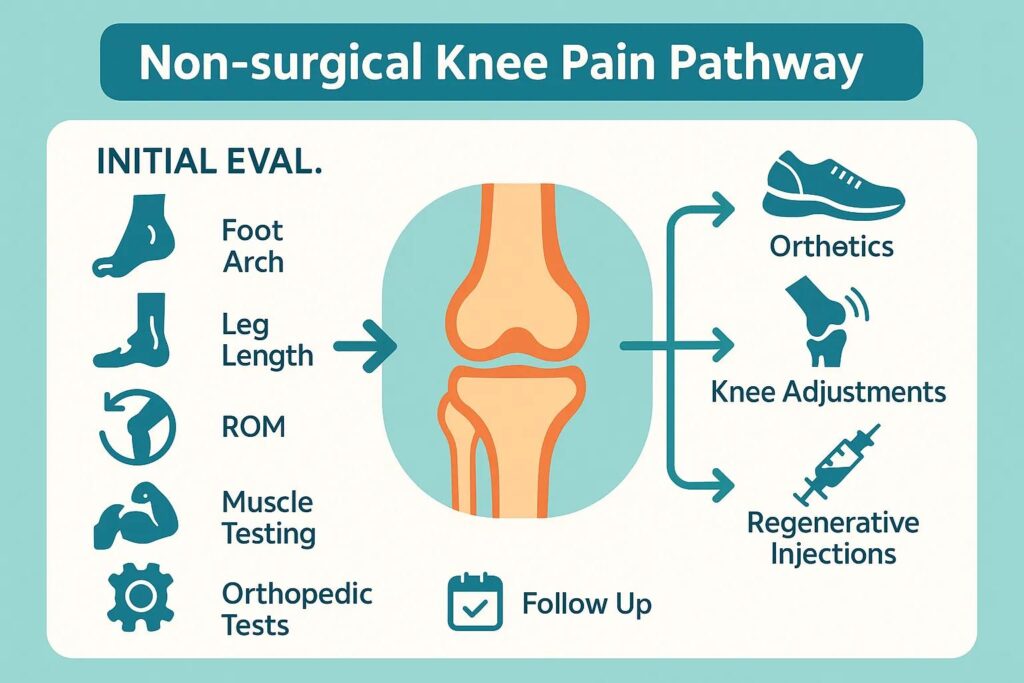
- Foot arch, leg length, range of motion, muscle strength, and orthopedic testing are core assessments for knee pain.
- Custom orthotics and shoe modifications address biomechanical issues contributing to knee pain and improve alignment.
- Chiropractic adjustments combined with exercises restore knee mobility and strengthen muscles to prevent future injuries.
- Regenerative injection therapies like PRP and Wharton’s Jelly promote tissue healing and reduce inflammation in the knee.
- Additional therapies such as red light and electrical stimulation support tissue repair and enhance pain relief.
- Continuous monitoring and follow-up ensure treatment effectiveness and adapt care based on patient progress.
- Surgical intervention is considered only for severe cases unresponsive to non-surgical treatments after thorough evaluation.
- Patients typically experience pain relief and improved function within weeks through natural, non-surgical knee pain management.
Core Evaluations for Knee Pain at Advanced Spine Health Center
Our approach begins with a detailed assessment of factors that contribute to knee pain and dysfunction. These evaluations allow us to tailor treatment plans precisely to each patient’s needs.
- Foot Arch Evaluation: We assess the arch of the foot to determine if it flattens excessively. If so, this can affect knee alignment and function.
- Anatomical Leg Length Assessment: Using modified Ferguson X-rays and precise biophysics measurements, we evaluate leg length discrepancies that may contribute to knee pain.
- Range of Motion (ROM) Testing: We measure the knee’s range of motion to identify limitations that may require targeted adjustments and exercises.
- Muscle Testing: This helps us identify muscle weaknesses around the knee and ankle, guiding strengthening exercises.
- Orthopedic Testing: We perform specific tests to evaluate injuries and structural issues affecting the knee.
Personalized Treatments to Address Knee Pain and Injuries
Based on our comprehensive evaluations, we develop customized treatment plans that integrate multiple therapies to address the root causes of knee pain and promote healing.
- Custom Orthotics and Foot-Ankle Muscle Control Training: For patients with flattened foot arches, we create custom orthotics to support proper foot biomechanics. We also train proper muscle control of the foot and ankle to improve stability and reduce knee strain.
- Shoe Shims and Modifications for Leg Length Discrepancies: If anatomical leg length differences are detected, we use shoe shims or collaborate with a local shoe cobbler to modify footwear. Follow-up X-rays and measurements confirm the correction.
- Knee Adjustments and Range of Motion Improvement: We use chiropractic adjustments combined with stretches and exercises to restore proper knee joint mobility and function.
- Muscle Strengthening Exercises: Targeted exercises are prescribed to strengthen weak muscles identified through muscle testing, enhancing knee stability and preventing future injuries.
- Regenerative Injection Therapies: For injury management and tissue healing, we utilize platelet-rich plasma (PRP) and Wharton’s Jelly injections. These biologic treatments stimulate healing and support tissue regeneration.
- Additional Healing Modalities: We incorporate red light therapy and electrical stimulation alongside therapeutic exercises to further promote tissue repair and reduce pain.
How We Ensure Effective Knee Pain Management
Our treatment process is dynamic and patient-centered. After initial evaluations and treatment initiation, we continuously monitor progress through follow-up assessments and patient feedback to ensure that interventions such as orthotics and shoe modifications are effective and that knee function is improving. Our goal is to provide lasting relief by addressing all contributing factors comprehensively.
What Patients Can Expect During Their Care Journey
Patients can expect a thorough initial evaluation covering foot biomechanics, leg length, knee range of motion, muscle strength, and injury status. Treatment plans are explained clearly, emphasizing non-surgical options tailored to individual needs. Many patients notice improvements in pain and function within a few sessions, with ongoing care focused on strengthening, mobility, and healing support. Natural pain management strategies, including therapeutic exercises, red light therapy, and electrical stimulation, complement the core treatments.
When Surgical Intervention May Be Considered
While our comprehensive non-surgical approach effectively manages many knee conditions, some cases with severe structural damage or persistent symptoms despite conservative care may require surgery. Signs indicating surgical consideration include ongoing pain, significant swelling, and functional limitations. Surgical options such as arthroscopy, ligament reconstruction, or total knee replacement should be discussed with an orthopedic specialist. Post-surgical rehabilitation is essential for recovery and may include physical therapy to restore strength and mobility.
Injection Therapies: PRP and Wharton’s Jelly for Enhanced Healing
At Advanced Spine Health Center, we utilize advanced orthobiologic injection therapies to support tissue healing and reduce knee pain. These include Platelet Rich Plasma (PRP) and Wharton’s Jelly (WJ) injections, which support the knee tissue, increase growth factors, and harness the body’s natural healing mechanisms.
Overview of PRP and Wharton’s Jelly Injections
- Platelet-Rich Plasma (PRP): PRP uses concentrated platelets from the patient’s own blood to stimulate and increase in growth factors, tissue repair and reduce inflammation.
- Wharton’s Jelly (WJ): Derived from umbilical cord tissue, WJ injections provide growth factors, cytokines, hyaluronic acid, and extracellular vesicles that promote healing and cushioning of the knee joint.
Benefits and Considerations
These biologic injections can accelerate healing and improve knee function, especially in cases of ligament or cartilage injury. These injections are generally safe and are a great alternative to tissue damaging injections such as cortiocosterioid injections.
Comparison of Injection Therapies for Knee Pain Relief
This table provides a clear comparison of four common injection therapies used for knee pain management: Platelet-Rich Plasma (PRP), Wharton’s Jelly (WJ), Hyaluronic Acid (HA), and Corticosteroid injections. Understanding the pros and cons of each option can help patients make informed decisions about their treatment plans.
| Injection Type | Pros | Cons |
|---|---|---|
| Platelet-Rich Plasma (PRP) | Utilizes the body’s own healing properties; minimal risk; promotes growth factors and tissue repair. | Results take some time as healing isn’t instant; not suitable for all patients; requires blood draw. |
| Wharton’s Jelly (WJ) | Rich in growth factors; provides cushioning; promotes healing without surgery. | Less research compared to other options; typically cost more than other injections. |
| Hyaluronic Acid (HA) | Improves joint lubrication; can provide immediate pain relief; well-studied with established efficacy. | Effects may be temporary; repeated injections may be necessary; potential for allergic reactions; no healing benefits |
| Corticosteroid Injections | Rapid pain relief; effective for inflammation; widely used and understood. | Potential for joint damage especially with repeated use; may mask underlying issues; side effects include weight gain and mood changes. Not suitable for all patients |
In summary, each injection therapy has its unique benefits and drawbacks. Patients should consult with their healthcare provider to determine the most suitable option based on their specific condition and treatment goals.
Wharton’s Jelly & Hyaluronic Acid for Knee OA
Osteoarthritis (OA) is the most common joint disorder in the United States of America (USA) with a fast-rising prevalence. Current treatment modalities are limited, and total knee replacement surgeries have shown disadvantages, especially for grade II/III OA. The interest in the use of biologics, including umbilical cord (UC)-derived Wharton’s jelly (WJ), has grown in recent years. The results from a preliminary study demonstrated the presence of essential components of regenerative medicine, namely growth factors, cytokines, hyaluronic acid (HA), and extracellular vesicles, including exosomes, in WJ. The proposed study aims to evaluate the safety and efficacy of intra-articular injection of UC-derived WJ for the treatment of knee OA symptoms.
Safety and efficacy of umbilical cord-derived Wharton’s jelly compared to hyaluronic acid and saline for knee osteoarthritis: study protocol for a randomized, controlled …, N Maffulli, 2021
Frequently Asked Questions About Our Knee Pain Treatment Approach
What Happens During the First Visit?
During your first visit, we conduct a comprehensive evaluation including foot arch assessment, leg length measurement with X-rays, knee range of motion testing, muscle strength evaluation, and orthopedic injury tests. We then discuss your personalized treatment plan based on these findings.
How Long Does Treatment Usually Take?
Treatment duration varies depending on the severity and nature of your knee condition. Many patients experience noticeable improvements within a few weeks, with ongoing care focused on strengthening and maintaining knee health.
Are There Side Effects to These Treatments?
Our treatments are generally safe and well-tolerated. Some patients may experience mild soreness after adjustments or injections, which typically resolves quickly. We prioritize patient safety and encourage open communication throughout your care.