
Chiropractic BioPhysics® (CBP) in Urbandale, Iowa
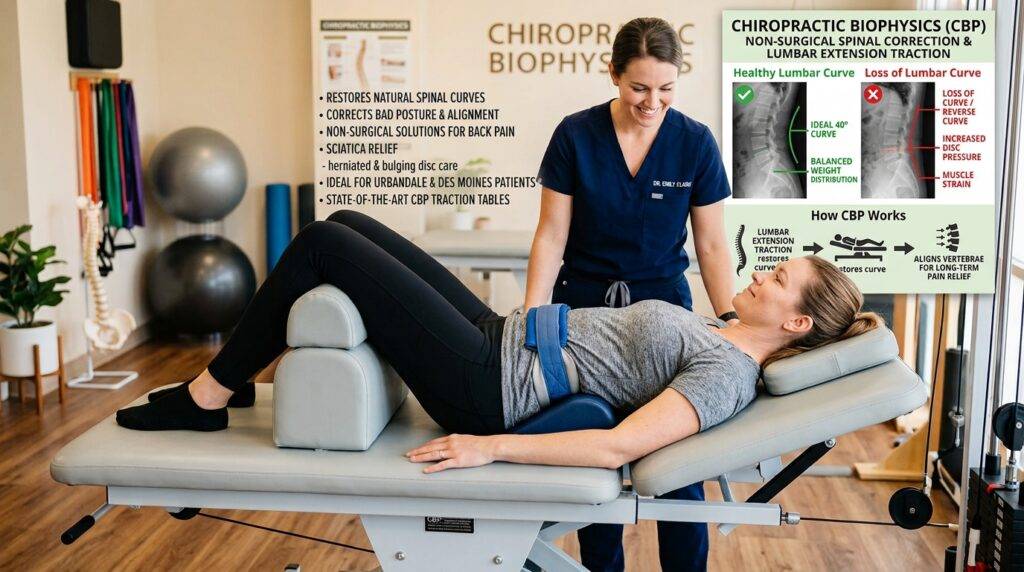
Chiropractic BioPhysics® (CBP) is an advanced, research-based chiropractic technique that uses specific spinal measurements, posture analysis, mirror-image procedures, traction, and corrective exercises to address measurable changes in spinal alignment and posture. At Advanced Spine Health Center in Urbandale, Iowa, CBP structural correction is a foundation of our approach to advanced chiropractic and advanced spinal care.
Medically Reviewed by Dr. Kyle Ruehle, DC
Jump to: What Is CBP? | CBP vs. Traditional Chiropractic | How We Evaluate Your Spine | How CBP Works | Treatment Plan | Research | Who May Benefit | Why Choose Us | Combining Therapies | FAQ | Areas We Serve
If you’re dealing with chronic back pain, neck pain, postural problems, recurring headaches, or other musculoskeletal issues that haven’t responded to previous treatment as you’d hoped, a structural approach may be worth exploring.
What Is Chiropractic BioPhysics®?
Chiropractic BioPhysics® is a measurement-driven chiropractic approach that uses objective spinal and postural data — not just symptoms — to guide a corrective treatment plan. A joint that feels better isn’t the only thing CBP is tracking; the technique measures changes in spinal curvature, alignment, and posture, and those numbers are what shape the corrective strategy for each patient.
CBP was developed by Dr. Donald D. Harrison and colleagues and incorporates concepts from biomechanics, engineering, physics, and rehabilitation. One of the defining principles of CBP is mirror-image correction. When a measurable postural or spinal deviation is identified, corrective procedures are selected to apply forces in the opposite direction of that deviation.
The goal of CBP structural rehabilitation is not simply to provide temporary symptom relief. The approach is designed to address measurable structural and postural changes while helping patients develop the strength, mobility, and habits needed to support those changes over time.
How Is CBP Different From Traditional Chiropractic?
The main difference is that CBP centers care around objective structural measurement and correction, while many traditional chiropractic approaches center care around symptom relief and joint mobility. There are many different approaches to chiropractic care, and chiropractors may use different techniques depending on their education, training, and clinical philosophy.
CBP may incorporate:
Specific measurements to evaluate spinal curves, translations, and posture
Mirror-image procedures selected according to the direction of measured deviations
Specialized extension traction as part of a structural rehabilitation program
Corrective exercises designed to reinforce changes between appointments
Periodic reassessment to evaluate changes in posture, structure, symptoms, and function
This does not mean that traditional chiropractic care is ineffective or inappropriate. Different patients need different approaches. CBP is simply a more measurement-driven structural approach for patients whose examination findings make this type of care appropriate.
CBP vs. Traditional Chiropractic Care
The table below compares the two approaches side by side.
<!– Format in Elementor using the .injection-table class: dark blue header row, light blue left column, per existing PRP table styling –>
| Factor | Chiropractic BioPhysics® (CBP) | Traditional Chiropractic Care |
|---|---|---|
| Primary focus | Structural correction of spinal alignment and posture | Joint mobility and symptom relief |
| Assessment method | Objective spinal measurements, standing X-rays, digital posture analysis | Primarily physical exam and reported symptoms |
| Treatment approach | Mirror-image procedures matched to measured deviations | Manual adjustments based on joint restriction |
| Use of traction | Specialized extension traction as part of a structural program | Not typically a core component |
| Home exercise component | Individualized mirror-image and corrective exercises | Varies by provider; often general stretches |
| Progress tracking | Re-measurement of posture/structure, plus symptoms and function | Primarily based on symptom change |
| Treatment goal | Address measurable structural and postural change over time | Restore joint function and reduce pain |
| Best suited for | Patients with measurable structural or postural findings | Patients seeking general joint and symptom-based care |
How We Evaluate Your Spine
A CBP-centered treatment plan begins with a comprehensive evaluation designed to identify measurable structural findings, not just to confirm a diagnosis. When clinically appropriate, standing spinal X-rays can provide valuable information about spinal curvature, alignment, pelvic position, and other objective structural markers. We may also use digital posture evaluation and biomechanical assessment to better understand how your body is positioned and functioning.
The point of this evaluation isn’t simply to take a picture of your spine — it’s to pull out the specific findings that connect to your symptoms, posture, or functional goals, and use that information to build an individualized treatment strategy.
Your examination findings, not a standard protocol, determine which corrective procedures may be appropriate for you.
How Chiropractic BioPhysics® Works
Mirror-Image Correction
Mirror-image correction works by applying corrective forces in the opposite direction of a patient’s measured postural or spinal deviation. If a portion of the spine has shifted or curved in a particular direction, the corrective position or exercise is built to pull against that shift rather than reinforce it. The exact procedure depends on the patient’s individual measurements.
Extension Traction
Extension traction applies a sustained corrective force to the spine and is typically used alongside other CBP procedures rather than as a stand-alone treatment. The objective is to provide a consistent corrective stimulus over time while combining it with other appropriate procedures.
Corrective Exercises
Corrective exercises reinforce the postural changes targeted in-office by giving the spine a consistent corrective stimulus between visits. Depending on your findings, mirror-image and other corrective exercises may be prescribed to reinforce the desired postural changes between visits. These exercises can also help improve strength, endurance, mobility, and your ability to maintain healthier movement patterns during everyday activities.
What Does a CBP Treatment Plan Look Like?
A CBP treatment plan generally follows five stages: assessment, plan development, active correction, reassessment, and long-term support — though the exact frequency and duration depend on your individual findings. Every patient is different, so your specific plan will depend on your examination findings, goals, response to treatment, and overall health.
Step 1 — Comprehensive Assessment
For a new patient, the first visit begins with a review of your health history, symptoms, posture, biomechanics, and clinically appropriate imaging. We evaluate measurable spinal curves, alignment, and other structural findings that may be relevant to your condition. You can expect a clear review of your symptoms, exam findings, and the most relevant next steps for your specific condition.
Step 2 — Individualized Structural Plan
Your examination findings are used to develop a personalized corrective strategy. This may include CBP mirror-image procedures, extension traction, corrective exercises, and other appropriate therapies.
Step 3 — Active Structural Correction
During the active phase of care, your treatment plan is followed consistently so that the spine receives repeated corrective input over time. The exact procedures, frequency, and duration depend on your individual presentation, with the goal of supporting recovery and healing over time, not just reducing symptoms.
Step 4 — Reassessment
Progress can be evaluated using changes in symptoms, function, posture, and, when appropriate, follow-up imaging. This provides a more complete picture of your progress than relying only on whether you feel better immediately after an appointment.
Step 5 — Long-Term Support
Once the active phase of care is complete, an individualized home exercise program and periodic reassessment may help support long term relief and lasting results after the active phase of care. The goal is to give you tools you can continue using outside the office rather than making your results dependent entirely on frequent appointments.
What Does the Research Say About CBP?
Published CBP research includes case reports, case series, controlled trials, and systematic reviews reporting measurable improvements in spinal curvature and patient-reported outcomes. As with any clinical approach, individual results vary, and findings from a specific study or patient population should not be interpreted as a guarantee of the same outcome for every patient.
For example, a 2023 case series involving patients with cervical acceleration-deceleration injuries reported an average 15.1-degree improvement in cervical lordosis along with a reduction in Neck Disability Index scores following CBP-based care.
A 2020 systematic review examined controlled trials using CBP methods to increase lumbar lordosis in people with low back disorders and reported evidence supporting improvement in lumbar lordosis.
A 2024 case series involving patients with lumbar spondylolisthesis also reported improvements in pain and lumbar curvature, with follow-up extending beyond one year.
A 2022 case series examining adults with high thoracic scoliosis reported measurable reductions in scoliotic curvature following CBP mirror-image procedures, adding to the evidence base for structural correction in scoliosis patients specifically.
These studies contribute to the research surrounding CBP, but they should be interpreted in context. Research results are not promises, and the appropriateness of CBP depends on the individual patient.
During your consultation, we can discuss the research that is most relevant to your condition and what a realistic treatment plan may look like based on your examination.
Who May Benefit From CBP?
CBP may be appropriate for patients whose examination identifies measurable postural or spinal alignment changes that may be relevant to their symptoms or functional goals. CBP may be considered for patients experiencing:
Chronic neck pain
Chronic low back pain
Postural abnormalities
Loss of normal spinal curvature
Certain disc-related conditions
Scoliosis and spinal asymmetries
Some patients recovering from whiplash or other motor-vehicle-related injuries
Recurring headaches when cervical or postural factors may be contributing
Persistent musculoskeletal problems that have not responded as hoped to previous treatment
CBP is not appropriate for every patient or every condition. A thorough examination is necessary to determine whether a structural correction approach is appropriate for you.
Why Choose Advanced Spine Health Center for Advanced Spinal Care and CBP?
Advanced Spine Health Center is a chiropractic clinic in Urbandale that combines advanced CBP-specific training with objective measurement tools and individualized care planning, rather than applying the same treatment to every patient. When appropriate, our CBP approach incorporates:
Advanced CBP training beyond standard chiropractic education
Standing spinal X-rays and posture-based analysis
Objective measurement of spinal alignment and posture
Mirror-image procedures based on individual structural findings
Extension traction and corrective exercises
Progress evaluation using symptoms, function, posture, and appropriate follow-up assessments
Individualized care plans rather than identical treatment for every patient
Dr. Kyle Ruehle, DC has owned and practiced at Advanced Spine Health Center in Urbandale since 2016 and, as a chiropractor, has pursued advanced CBP training beyond standard chiropractic education.
Our goal is to combine that specialized training with a thorough evaluation and an individualized approach to advanced spinal care.
Can Other Therapies Be Combined With CBP?
Yes — CBP is often combined with complementary therapies such as spinal decompression, red light therapy, custom orthotics, or regenerative procedures, though not every patient needs the same combination. CBP structural correction is a foundation of our approach, but the specific combination depends on your examination findings and goals.
These therapies are not automatically added to every CBP plan. They are considered when they may provide a useful complement to the patient’s specific needs.
For more information, visit our dedicated pages for spinal decompression, PRP injections, Wharton’s Jelly, red light therapy, and custom orthotics.
Frequently Asked Questions About CBP
How is CBP different from regular chiropractic care?
One of the main differences is the emphasis on structural measurement and correction. While many chiropractic approaches focus primarily on symptoms, joint mobility, and function, CBP uses specific measurements and corrective procedures designed to address measurable changes in spinal alignment and posture.
How long does CBP treatment take?
Treatment length varies considerably from patient to patient. Some patients may need a relatively short course of care, while patients with more significant or longstanding structural changes may require several months of rehabilitation. Your recommended schedule should be based on your examination findings, goals, and response to care rather than a one-size-fits-all timeline.
Does insurance cover CBP treatment?
Insurance coverage depends on your specific plan and benefits. Many insurance plans provide coverage for chiropractic services, but coverage for particular procedures or services can vary. Our team can help you understand your available coverage and self-pay options before care begins.
What conditions like back pain does CBP work best for?
CBP may be most appropriate when an examination identifies measurable structural or postural findings that may be relevant to a patient’s symptoms or goals. Chronic neck and back pain, postural abnormalities, certain spinal curvature changes, scoliosis, and some disc-related conditions may be considered for CBP care. An examination is necessary to determine whether CBP is appropriate for your specific situation.
Will CBP replace my need for other treatments?
Not necessarily. Some patients may benefit from a focused CBP plan, while others may benefit from combining structural rehabilitation with other appropriate services. The goal is to select care based on the patient’s individual findings rather than assuming one treatment is appropriate for everyone.
Areas We Serve
Advanced Spine Health Center is located in Urbandale and serves patients throughout the Des Moines metro, including Urbandale, West Des Moines, Clive, Johnston, Waukee, Ankeny, Des Moines, Grimes, Windsor Heights, Norwalk, and surrounding communities.
If you’re searching for Chiropractic BioPhysics® in Urbandale or the greater Des Moines area, our team can help you determine whether a structural approach is appropriate for your condition.
Start With a CBP Consultation
If you’re looking for more than temporary symptom relief and want your spinal alignment and posture evaluated as part of a comprehensive chiropractic assessment, Chiropractic BioPhysics® may be worth exploring as an approach that aims to address the root cause of structural problems, not only temporary pain relief.
We’ll evaluate your individual findings, explain what we see, and determine whether a CBP-based structural rehabilitation plan makes sense for you, with the goal of lasting structural change that may help relieve pain and support overall wellness when appropriate.
Schedule a CBP consultation at Advanced Spine Health Center in Urbandale, Iowa, if you’re interested in finding out whether you’re a good candidate and want to take the first step toward a more individualized approach to advanced spinal care.
[Contact Us Today to Schedule Your Appointment →]
References
Oakley PA, Harrison DD, Harrison DE, Haas JW. Evidence-based protocol for structural rehabilitation of the spine and posture: review of clinical biomechanics of posture (CBP) publications. Journal of the Canadian Chiropractic Association. 2005;49(4):270-296.
Fedorchuk C, Lightstone D, et al. Positive Outcomes Following Cervical Acceleration-Deceleration (CAD) Injury Using Chiropractic BioPhysics® Methods. Journal of Clinical Medicine. 2023.
Oakley PA, et al. Improvement in Pain, Quality of Life, and Urinary Dysfunction following Correction of Lumbar Lordosis Using Chiropractic BioPhysics® Structural Spinal Rehabilitation: A Case Series with >1-Year Long-Term Follow-Up. Journal of Clinical Medicine. 2024.
Oakley PA, Ehsani NN, Moustafa IM, Harrison DE. Restoring lumbar lordosis: a systematic review of controlled trials utilizing Chiropractic BioPhysics® non-surgical approach to increasing lumbar lordosis in the treatment of low back disorders. Journal of Physical Therapy Science. 2020;32(9):601-610.
Oakley PA, Kallan SZ, Harrison DE. The reduction of high thoracic scoliosis in adults by mirror image® blocking: a Chiropractic BioPhysics® case series. Journal of Physical Therapy Science. 2022;34(6):467-472. PMID: 35698559.