Bulging Disc vs. Herniated Disc: Causes, Symptoms, and Treatment in Urbandale, Iowa
Medically Reviewed by Dr. Kyle Ruehle, DC — Advanced Spine Health Center, Urbandale, Iowa (serving the Des Moines metro since 2016)
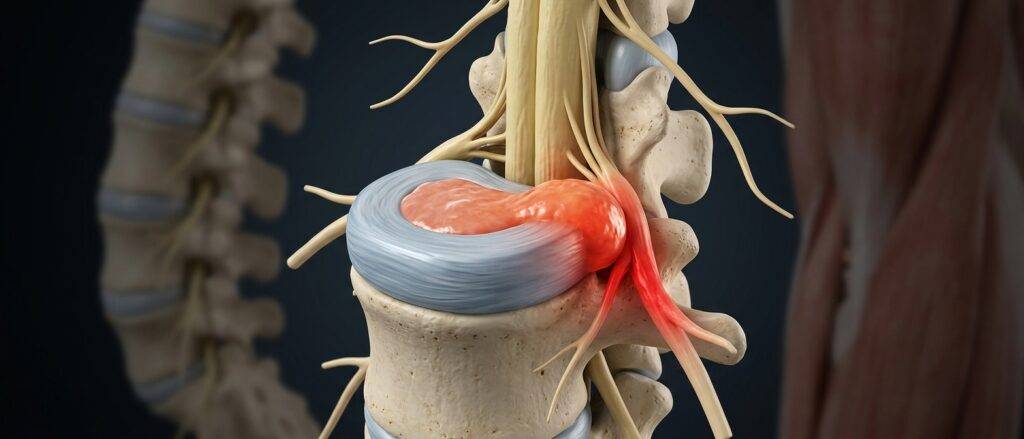
If you've been told you have a "bulging disc" or a "herniated disc," you've probably noticed those two terms get used almost interchangeably — by friends, by the internet, sometimes even in imaging reports. They aren't the same thing, and the difference actually matters for what you should expect next.
This page walks through what a spinal disc is, how a bulge differs from a true herniation, what causes each one, when symptoms mean something serious, and what the evidence actually says about treatment — including what tends to happen if you do nothing at all. At Advanced Spine Health Center in Urbandale, we evaluate disc-related pain as part of a broader structural picture rather than treating an MRI report in isolation, and we'll explain why that distinction matters throughout this page.
Key Takeaways
- A "bulging disc" and a "herniated disc" describe different things on imaging, and the difference affects what it means for you.
- Disc bulges — and even some herniations — show up on imaging in people who have no back pain at all. A finding on a scan is not the same as a diagnosis.
- Leg pain, numbness, or tingling that travels below the knee often points to a disc affecting a nearby nerve root, not just general back pain.
- A small number of symptoms — like new bowel or bladder changes or numbness in the saddle area — are emergencies and need same-day medical attention, not a scheduled appointment.
- Most disc herniations improve with time and conservative care, and a meaningful share shrink or resolve on their own.
- Surgery is a legitimate option for specific situations, not the default first step for most people.
Table of Contents
What Is a Spinal Disc? | Bulging Disc vs. Herniated Disc | Causes & Risk Factors | Symptoms | When It's an Emergency | How It's Evaluated | Does It Heal on Its Own? | Treatment Options | How We Approach It | Disc Herniation in the Neck | FAQ
What Is a Spinal Disc?
Between each pair of vertebrae in your spine sits an intervertebral disc — a shock-absorbing cushion made of two main parts. The outer layer, the annulus fibrosus, is a series of tough, fibrous rings arranged a bit like the layers of an onion. The inner core, the nucleus pulposus, is a softer, gel-like material that helps the disc distribute load and allow controlled movement between vertebrae.
Discs don't just cushion — they also help maintain the space between vertebrae where spinal nerves exit toward the arms and legs. When a disc's structure changes, whether from gradual wear or a specific injury, it can affect that space and, in some cases, put pressure on a nearby nerve root. That's the mechanical link between a disc problem and the pain, numbness, or weakness that can travel down an arm or leg.
Bulging Disc vs. Herniated Disc: What's the Difference?
The distinction comes down to how much of the disc's circumference is involved and whether the disc material stays where it belongs. Spine radiologists use a standardized nomenclature (updated in 2014 by a combined task force of the North American Spine Society, the American Society of Spine Radiology, and the American Society of Neuroradiology) to keep these terms consistent.1
A bulge means disc material extends beyond the vertebral margin around more than a quarter of the disc's circumference. Because it's diffuse rather than focal, a bulge is technically not classified as a herniation at all — it's often part of the disc's normal aging process rather than a discrete injury.1
A herniation is focal — involving less than 25% of the disc's circumference — and is broken down further by shape:
| Type | What It Means | Contained? | What It Often Means for You |
|---|---|---|---|
| Bulge | Disc extends beyond the vertebral margin around more than 25% of its circumference | Yes | Very common with age; frequently found on imaging in people with no pain at all |
| Protrusion | Focal herniation where the base is wider than the displaced material at its furthest point | Usually | A true herniation, but the annulus is generally still intact |
| Extrusion | Focal herniation where the displaced material is wider than its base | Often not | Involves a defect in the outer annulus; more likely to shrink substantially over time |
| Sequestration | A fragment has completely separated from the parent disc | No | The most structurally significant type, but also the type most likely to resorb on its own |
That last point tends to surprise people: the more "severe"-sounding types of herniation — extrusion and sequestration — are generally the ones most likely to shrink significantly over time, which we'll get into later in this page.
Here's the other piece that matters just as much as the terminology: disc bulges and even disc protrusions are extremely common in people who have never had a day of back pain. A large systematic review of imaging in pain-free adults found disc bulge prevalence rising from about 30% at age 20 to roughly 84% by age 80, and disc protrusion prevalence around 29% at age 20 up to 43% at age 80.2 Finding a bulge or even a protrusion on your MRI doesn't automatically explain your pain, and it doesn't mean something has gone catastrophically wrong. It's one piece of information that has to be interpreted alongside your actual symptoms and exam findings — not read in isolation.
Causes and Risk Factors
Discs change gradually over decades as part of normal aging — they lose water content and become less flexible, which is part of why bulges become more common with age regardless of symptoms. On top of that gradual process, a true herniation more often has an identifiable trigger or contributing pattern, including:
- A specific lifting, twisting, or bending injury, especially under load
- Repetitive mechanical stress — frequent bending, lifting, or whole-body vibration (long-haul driving, for example)
- Genetics, which appears to influence how a person's discs age and how much load they can tolerate
- Smoking, which is associated with reduced nutrient delivery to disc tissue and a higher rate of disc degeneration
- Excess body weight, which increases the mechanical load the lower spine has to manage
- Prolonged sitting and general deconditioning, which reduce the muscular support that normally shares load with the spine
Because of how weight and movement are distributed through the lumbar spine, the two lowest discs — L4-L5 and L5-S1 — are the most common sites for a lumbar disc herniation. That's also the region most likely to produce sciatic-type leg pain, since the nerve roots that form the sciatic nerve exit the spine at those levels.
Symptoms of a Disc Bulge or Herniated Disc
Not every disc bulge or herniation causes symptoms — as the imaging data above shows, plenty don't. When a disc problem does cause symptoms, they generally fall into two categories:
Local back pain. Aching or sharp pain centered in the low back, sometimes worse with sitting, bending forward, or coughing and sneezing (which briefly increase pressure within the disc).
Radicular symptoms (sciatica). Pain, numbness, tingling, or weakness that travels down one leg — sometimes past the knee and into the calf or foot — when disc material is affecting a nearby nerve root. The specific pattern of where that pain travels can help identify which nerve root, and therefore which disc level, is likely involved.
It's worth repeating: the size of a disc bulge or herniation on imaging doesn't reliably predict how much pain a person feels.2 Some people with a large herniation have mild symptoms; others with a modest bulge have significant pain. That mismatch is exactly why a thorough history and physical exam — not just a scan — is central to figuring out what's actually driving your symptoms.
When It's a Medical Emergency: Cauda Equina Warning Signs
In rare cases, a large central disc herniation can compress the bundle of nerve roots at the bottom of the spinal canal (the cauda equina), and this is a true medical emergency. Seek immediate emergency care — not a chiropractic appointment — if you experience any of the following:3
- New numbness in the saddle area (inner thighs, groin, or around the tailbone)
- New difficulty starting urination, loss of the urge to urinate, or urinary retention
- New bowel or bladder incontinence
- Progressive weakness or numbness affecting both legs
- Sudden loss of sexual function or sensation
These symptoms mean nerve function is being lost in real time, and outcomes are closely tied to how quickly the pressure is relieved. This is not something to monitor overnight or "see if it gets better" — go to an emergency room immediately.
How a Disc Bulge or Herniated Disc Is Evaluated
Evaluation starts with a detailed history and a physical exam, including strength, reflex, and sensory testing to check whether a specific nerve root appears to be involved, along with movements and orthopedic tests that can help reproduce or clarify your symptoms.
At Advanced Spine Health Center, we also evaluate spinal structure directly. Our standard series includes an AP view, a modified Ferguson view, a lateral view, and a thoracic view, so we can see how the rest of the spine's structure — not just the painful segment — may be contributing. We run those X-rays through PostureRay, a physics-based analysis software, to measure specific structural findings such as anatomical leg length inequality (ALLI), pelvic morphology measurements like PTSIA, pelvic incidence, lumbar lordosis, vertebral alignment (including listhesis), and scoliosis. That structural picture helps us understand what may be contributing to load on a particular disc level, not just where the pain happens to be.
We don't order an MRI for every patient with back or leg pain, and that's consistent with current clinical guidelines, which generally reserve MRI for cases involving red-flag symptoms, significant or progressive neurological findings, or situations where a reasonable course of conservative care hasn't produced progress.4 In practice, that means we typically refer out for MRI when red flags are present or when treatment isn't producing the improvement we'd expect — not as a routine first step for every low back complaint.
Does a Herniated Disc Heal on Its Own?
This is one of the most reassuring — and most underexplained — parts of disc herniation care. The body treats herniated disc material somewhat like foreign tissue: immune cells recognize it and gradually break it down, while the disc itself dehydrates and shrinks. This process is called spontaneous resorption, and it's genuinely common, not a rare exception.
A systematic review of the available research found that a substantial share of herniated discs shrink significantly or resolve with conservative management alone, with most of that change happening within about three to six months.5 Resorption tends to be more likely and more dramatic with extruded or sequestered fragments — the types that sound most alarming on a radiology report — and less pronounced with contained protrusions. Larger herniations, in particular, sometimes shrink the most.
This doesn't mean every disc problem should simply be left alone. It means that, for most patients without red-flag symptoms or a significant progressive neurological deficit, a period of guided conservative care is a reasonable and evidence-supported starting point — not a consolation prize before "real" treatment.
Treatment Options for a Disc Bulge or Herniated Disc
There isn't one correct treatment for a disc bulge or herniation — the right combination depends on the location, type, your neurological findings, how long you've had symptoms, and how you respond along the way. Clinical guidelines generally support starting with conservative care for most patients who don't have progressive neurological deficits or red-flag symptoms, then escalating based on response.4 For some patients, short-term over-the-counter or prescription anti-inflammatory medication — managed by your physician — can help make the acute phase more tolerable, even though it doesn't address the disc itself.
Chiropractic Care and Structural Evaluation
Chiropractic adjustments are commonly used for acute back pain and sciatica associated with a disc problem. In a randomized, double-blind trial of patients with acute back pain and sciatica who had a confirmed disc protrusion on imaging, active spinal manipulation produced better outcomes than simulated manipulation.6 As a Chiropractic BioPhysics® (CBP)-based practice, we combine chiropractic adjustments with a structural evaluation of posture, spinal alignment, and biomechanics — rather than adjusting the painful area in isolation — since factors like pelvic tilt, lumbar curve, and overall spinal alignment can influence how much load a given disc level is under.
Corrective Traction and Spinal Decompression
We use a specialized supine traction and decompression table, developed by Dr. Ruehle, that applies traction at approximately a 0-degree pull with patient-specific loading that's increased as tolerated. One randomized controlled trial by researchers associated with the Chiropractic BioPhysics® approach found that extension traction improved outcomes specifically for patients with discogenic lumbosacral radiculopathy.7 That said, it's one trial from CBP-affiliated researchers, and the broader traction and decompression literature is more mixed — generally more supportive of short-term relief than of durable, long-term change on its own. We treat corrective traction as one component of a broader plan rather than a stand-alone fix for a disc problem.
Rehabilitation and Movement
Staying appropriately active, rather than prolonged bed rest, is associated with better outcomes for most disc-related back and leg pain. Core stabilization and progressive strengthening are consistently supported in the research and guidelines as part of both conservative and post-treatment care.4 Directional-preference approaches — finding the movements and positions that centralize or reduce leg symptoms — can also help guide a home exercise program in appropriate cases.
Other Supportive Options
Depending on the individual case, care may also incorporate red light therapy or other supportive modalities alongside rehabilitation, and — for appropriate disc-related pain that hasn't responded adequately to a course of conservative care — biologic injections such as platelet-rich plasma (PRP), which we perform in-office using a transforaminal approach for suitable candidates. PRP isn't something we reach for on its own, and it isn't appropriate for every disc presentation; when it's considered, it's one option evaluated within your broader treatment plan. You can read more on our PRP injections page.
Epidural Steroid Injections
Epidural steroid injections, administered by a pain management physician or interventional specialist, are a legitimate option for radicular pain that hasn't adequately responded to conservative care. Research generally shows a short-to-intermediate-term benefit for pain and function, though results vary and aren't universal.4 This isn't a service we perform in-office, but it's a reasonable next step to discuss with your physician if conservative care stalls.
When Surgery May Be Considered
Surgery is not the default treatment for a disc herniation, and it isn't necessary for most people. It becomes an important consideration for cauda equina syndrome (an emergency, addressed above), for significant or progressive neurological weakness, or for persistent, disabling radicular pain that hasn't improved despite a genuine trial of conservative care.
The largest and most closely followed research on this question, the Spine Patient Outcomes Research Trial (SPORT), compared surgical and non-operative treatment for lumbar disc herniation over four years. Patients who had surgery saw larger, faster improvements in pain and function — but patients treated non-operatively also improved substantially, and that improvement held up over the full four years.8 The "choice" between surgery and conservative care in that trial wasn't as clean as it sounds, either: nearly half of the patients initially assigned to non-operative care eventually had surgery, while a substantial share assigned to surgery never had the procedure. Realistically, it's a decision that gets revisited over time based on how you respond, not a single fork in the road on day one.
How Advanced Spine Health Center Approaches Disc Bulges and Herniated Discs
We don't treat a disc bulge or herniation as an isolated finding on a scan. We start with your history and a thorough exam, add a structural evaluation using X-ray and PostureRay analysis, and use that combined picture to understand what's likely driving your symptoms — not just where the pain happens to be.
From there, care is individualized. Depending on your presentation, that may include chiropractic adjustments, CBP-based structural correction, corrective traction or decompression, rehabilitative exercise, and, for select cases that haven't responded to conservative measures, biologic injections such as PRP. Not every patient needs every one of these, and we'll walk you through the reasoning behind whatever combination we recommend. When something falls outside what conservative, structurally focused care can reasonably address — including any red-flag symptoms — we'll tell you directly and help you get to the right additional evaluation, whether that's imaging, a specialist, or a surgical consultation.
What About a Herniated Disc in the Neck?
Everything above focuses on the lumbar (low back) spine, since that's where disc herniations and related searches are most common — but discs in the cervical (neck) spine can bulge or herniate the same way, causing neck pain, and, when a nerve root is involved, pain, numbness, or tingling that radiates into the shoulder, arm, or hand. Many of the same principles apply: imaging findings are common even without symptoms, most cases improve with conservative care, and structural evaluation matters. For a closer look at cervical disc issues specifically, see our neck pain page.
Frequently Asked Questions
What's the actual difference between a bulging disc and a herniated disc?
A bulge extends around more than 25% of the disc's circumference and isn't technically classified as a herniation — it's often part of normal age-related change. A herniation (protrusion, extrusion, or sequestration) is a focal displacement of disc material affecting less than 25% of the circumference, and represents a more specific structural change.
Can a herniated disc heal without surgery?
Often, yes. Research shows a substantial share of herniated discs shrink or resolve on their own over three to six months, particularly extruded or sequestered fragments. Most people without red-flag symptoms or significant progressive weakness do well with a course of conservative care.
Is chiropractic care safe if I have a herniated disc?
For many patients, yes — research has shown benefit from spinal manipulation in patients with acute back pain and sciatica from a confirmed disc protrusion. That said, care should be individualized, and we screen for red-flag symptoms and significant neurological findings before recommending a specific approach.
What symptoms mean I should go to the ER instead of scheduling an appointment?
New saddle numbness, new bowel or bladder changes, or rapidly progressing weakness in both legs are signs of a potential cauda equina emergency. Go to an emergency room right away rather than waiting for a scheduled visit.
How long does it take a herniated disc to feel better?
It varies by case, but many patients see meaningful improvement within weeks to a few months of starting conservative care, and imaging-confirmed shrinkage most often occurs within three to six months. Larger or more severe-appearing herniations don't necessarily take longer — some of them resolve the most dramatically.
My MRI shows a disc bulge — does that mean I need surgery?
Not by itself. Disc bulges are extremely common with age and are frequently found in people with no back pain at all. Surgery is reserved for specific circumstances, like cauda equina syndrome, significant progressive weakness, or persistent disabling symptoms that haven't responded to a genuine trial of conservative care — not for the presence of a bulge on a scan.
Can I keep exercising with a disc bulge or herniation?
In most cases, staying appropriately active is better than prolonged rest. The right types and amounts of movement depend on your specific presentation, which is part of why an individualized evaluation matters before starting or resuming an exercise program.
Do you order MRIs at Advanced Spine Health Center?
We evaluate spinal structure in-house using X-ray and PostureRay analysis. We refer out for MRI when red-flag symptoms are present or when a course of treatment isn't producing the progress we'd expect — not as a routine step for every patient.
Disc Bulge and Herniated Disc Treatment in Urbandale, Iowa
If you're dealing with low back pain, sciatica, or a disc bulge or herniation you've already been told about, we can evaluate your spine's structure and symptoms together to figure out what's actually contributing — and build a plan around your specific findings, not a generic protocol. We see patients from Urbandale and throughout the Des Moines metro, including West Des Moines, Clive, Johnston, and Grimes. Contact Advanced Spine Health Center to schedule an evaluation.
About the Author
Dr. Kyle Ruehle, DC, is the owner and treating chiropractor at Advanced Spine Health Center in Urbandale, Iowa, serving patients throughout the Des Moines metro since 2016. He is a graduate of Simpson College and Palmer College of Chiropractic.
References
- Fardon DF, Williams AL, Dohring EJ, et al. Lumbar disc nomenclature: version 2.0. Spine J. 2014;14(11):2525-2545. PubMed
- Brinjikji W, Luetmer PH, Comstock B, et al. Systematic literature review of imaging features of spinal degeneration in asymptomatic populations. AJNR Am J Neuroradiol. 2015;36(4):811-816. PubMed
- American Association of Neurological Surgeons. Cauda Equina Syndrome. AANS Patient Information
- Kreiner DS, Hwang SW, Easa JE, et al. An evidence-based clinical guideline for the diagnosis and treatment of lumbar disc herniation with radiculopathy. Spine J. 2014;14(1):180-191. PubMed
- Chiu CC, Chuang TY, Chang KH, Wu CH, Lin PW, Hsu WY. The probability of spontaneous regression of lumbar herniated disc: a systematic review. Clin Rehabil. 2015;29(2):184-195. PubMed
- Santilli V, Beghi E, Finucci S. Chiropractic manipulation in the treatment of acute back pain and sciatica with disc protrusion: a randomized double-blind clinical trial of active and simulated spinal manipulations. Spine J. 2006;6(2):131-137. PubMed
- Moustafa IM, Diab AA. Extension traction treatment for patients with discogenic lumbosacral radiculopathy: a randomized controlled trial. Clin Rehabil. 2013;27(1):51-62. PubMed
- Weinstein JN, Tosteson TD, Lurie JD, et al. Surgical versus nonoperative treatment for lumbar disc herniation: four-year results for the Spine Patient Outcomes Research Trial (SPORT). Spine (Phila Pa 1976). 2008;33(25):2789-2800. PubMed
This page is for educational purposes and does not replace an individualized medical evaluation. If you're experiencing new bowel or bladder changes, saddle numbness, or progressive leg weakness, seek emergency medical care immediately.

OFFICE HOURS
Monday
9:00am – 6:30pm
Tuesday
9:00am – 6:30pm
Wednesday
9:00am – 6:30pm
Thursday
9:00am – 6:30pm
Friday
9:00am – 6:30pm
Saturday
Closed
Advanced Spine Health Center
8431 Hickman Road
Urbandale, IA 50322
(515) 423-0708